French CNF Application and Refusal: Legal Requirements and What to Do Next
1. What Is a French CNF?
Book a Consultation with an Attorney in French Citizenship by Descent
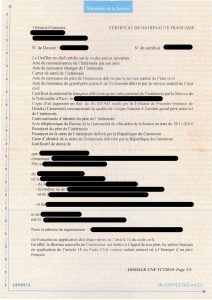
A Certificate of French Nationality (CNF - Certificat de Nationalité Française) is an official document issued by French authorities confirming that a person is a French citizen.
It is only one of the ways to prove French citizenship. It is also the strongest way to prove that you're French. Once you have it, your status as French citizen can only be contested after a court procedure engaged and proven by the Administration.
It is often requested in complex nationality cases, especially when:
• citizenship is based on descent
• birth in former French colony is involded
• authorities have doubts about nationality status
👉 The CNF is not the origin of nationality — it is only proof of it.
Someone who obtains a CNF is often meant to have been a French citizen his/her whole life.
2. When Is a CNF Required?
A CNF is typically requested when:
• there is no recent French passport or ID card
• civil status records are incomplete or unclear
• the administration considers that nationality is not “obvious”
However, in many cases, applicants are asked to provide a CNF even when they already hold valid civil status proof, which can lead to unnecessary procedures.
If your birth has been registered with the French authorities, please check in our article on How to Challenge a Passport rejection. Don't fall into unecessary CNF applications.
3. How CNF Applications Are Examined
A CNF application requires a detailed review of your nationality history.
You must generally prove:
• your line of descent (if applicable)
• that French nationality was transmitted legally through generations
• that no loss of nationality occurred for each generation subsequently
This often involves:
• birth certificates
• marriage certificates
• parental documents
• naturalization or retention records
• recent proof of use of citizenship (possession d'état de Français)
👉 It is a highly technical and document-heavy process. And you have the burden to prove all positive and negative conditions for your whole chain of filiation.
4. Why CNF Applications Are Frequently Refused
CNF refusals are common and usually based on:
• missing or incomplete genealogical evidence
• inconsistencies in civil status records
• inability to prove uninterrupted transmission of nationality
• doubts about loss or retention of French citizenship
• lack of evidence of use of French citizenship (when applicable) - possession d'état
• lack of evidence of residence in France of an ancestor (when applicable)
👉 In most cases, the refusal is based on insufficient proof, not necessarily absence of rights.
5. What Happens After a CNF Refusal?
A CNF refusal is not final, but can be heavy. You can challenge it, but in the meantime, you are likely to have your French documents not renewed or not issued.
You generally have some main options:
Option 1: Challenge the refusal (counter the CNF rejection decision)
You may contest the decision before a court if:
• the legal reasoning is weak
• the administration misapplied the law
• or your evidence was not properly considered
You can do it up to 6 months after the notification of the rejection decision. Focus on the missing evidence or mistake of the Administration.
Option 2 : Challenge your status as French citizen in front of a judge - action déclaratoire de nationalité
You can do it at any time.
This is a general claim where you will need to produce all proof of your citizenship again. This won't be focused on the eventual mistake done by te administration while ruling about your CNF application. This 'action déclaratoire de nationalité' is broad and can be used when there are points hard to prove in your case for this can drive the focus of the judge to other matters.
Option 3: Reapply for CNF with a stronger file
A new application may be more appropriate when:
• documents were missing
• the genealogy was incomplete
• or errors can be corrected
👉 Choosing the correct strategy is essential.
Option 4: Apply for Reinstatement into French citizenship - article 21-14 civil code
After a refusal based on the 50 years' rule (article 30-3), one might become eligible for Reintegration into French citizenship.
This application is more advised when
• one speaks French and has a language test
• one has other significant and documented tied with France (economic, family, cultural)
6. CNF vs Other Legal Paths
In some cases, a CNF is not the only or best route.
Depending on your situation, alternatives may include:
• passport-based recognition of nationality
• administrative litigation
• or correction of civil status documentation
👉 A CNF is often the most demanding administrative path. The means to contest a refusal of a CNF are also very demanding, as they require the intervention of a civil judge in France.
7. Strategic Consideration
CNF procedures are:
• long (often many months or more)
• document-intensive
• legally complex
Because of this, many cases require a strategic assessment before applying or reapplying.
Conclusion
The CNF is a key document in French nationality law, but it is also one of the most complex administrative procedures.
Once you bear it, the Administration can no longer contest your status as French citizen without going to Court for that. Further, it is mentioned in your birth certificate. Therefore, even if you lose the documents, it can easily be proven by issuing a new birth certificate.
Understanding:
• when it is required
• why it is refused
• and what options exist afterward
is essential to avoid delays and repeated refusals.
If you are dealing with a CNF application or refusal, your case may require a strategic legal analysis.
I assist international clients with:
• CNF applications and refusals
• French nationality by descent
• administrative and passport-related disputes
👉 Contact for a case assessment to determine the best legal strategy for your situation.
Comments
Post a Comment